| Melted snow, budding trees, longer days: they’re all signs that the warmer months are nearing. For many of us, these seasonal hallmarks are reminders to start spring cleaning in and around our homes.
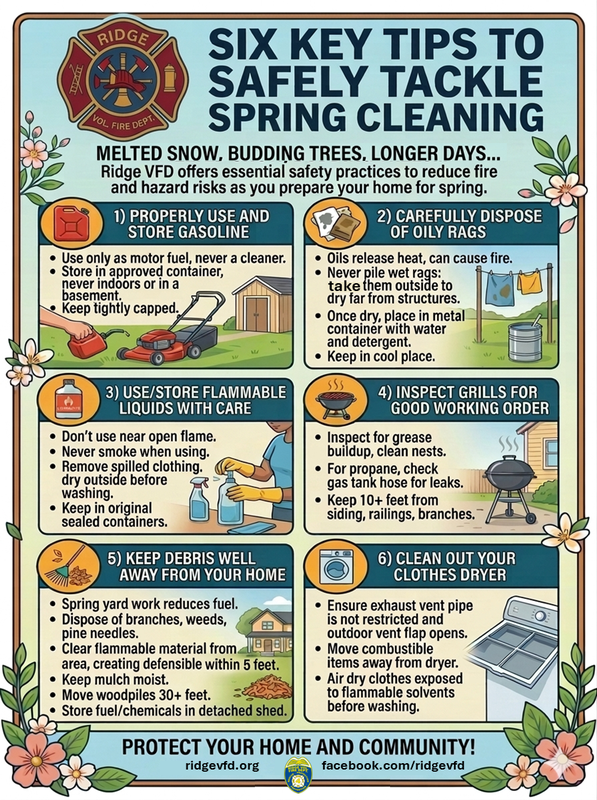
As individuals prepare their homes and landscapes for the upcoming months—by operating lawnmowers, removing debris, repairing chipped paint, and undertaking various projects—Ridge VFD offers the following six essential safety practices and supporting recommendations to help reduce the risk of fire and related hazards:
1) Properly use and store gasoline
• Use gasoline only as motor fuel, never as a cleaner or to break down grease.
• Only store gasoline in a container that is sold for that purpose and never bring it indoors, even in small amounts.
• Never store gasoline containers in a basement or in the occupied space of a building. Keep them in a detached garage or an outdoor shed.
• Make sure the container is tightly capped when not in use.
2) Carefully dispose of rags with paint and stain
The oils commonly used in oil-based paints and stains release heat as they dry. If the heat is not released in the air as the rags dry, the heat is trapped, builds up and can cause a fire.
• Never leave cleaning rags in a pile. When you’re finished using the rags, take them outside to dry, keeping them well away from the home and other structures.
• Hang rags outside or spread them on the ground and weigh them down so that they don’t blow away.
• Put dried rags in a metal container, making sure the container is tightly covered. Fill the container with a water and detergent solution, which will break down the oils.
• Keep containers of oily rags in a cool place out of direct sunlight and away from other heat sources. Check with your town for information on how to properly dispose of them.
3) Use/store flammable and combustible liquids with care
• Flammable and combustible liquids should not be used near an open flame.
• Never smoke when working with these liquids.
• If you spill liquids on your clothing, remove your clothing and place it outside to dry. Once dry, clothing can be laundered.
• Keep liquids in their original containers. Keep them tightly capped or sealed. Never store the liquids in glass containers.
4) Inspect grills to ensure they’re in good working order
• Inspect your grill carefully and make sure it’s free of grease or fat buildup. Clean out any nests, spider webs, or other debris you may find.
• For propane grills, check the gas tank hose for leaks before using it for the first time each year.
• Always keep grills at least 10 feet away from vinyl siding, deck railings, and overhanging branches.
5) Keep debris well away from your home
Every year, wildfires burn across the U.S., with more and more people living in communities where wildfires are a real risk. Spring yard work is a primary defense against outdoor fires.
• Dispose of branches, weeds, leaves, pine needles, and grass clippings to reduce fuel for fire.
• Remove leaves, pine needles, and other flammable material from the roof, gutters, and on or under the deck to help prevent embers from igniting your home.
• Remove dead vegetation and other flammable materials, especially within the first five feet of the home.
• Keep mulch moist and away from wooden stairs or siding, as it can easily ignite from a stray cigarette or spark.
• Move construction material, trash, and woodpiles at least 30 feet away from the home and other outbuildings.
6) Clean out your clothes dryer
• Make sure the air exhaust vent pipe for your dryer is not restricted and that the outdoor vent flap will open when the dryer is operating. This includes making sure the outdoor vent flap is not covered by snow.
• Move things that can burn, such as boxes, cleaning supplies and clothing, away from the dryer.
• Clothes that have come in contact with flammable substances like gasoline, paint thinner, or similar solvents should be laid outside to dry, then can be washed and dried as usual. |